On April 17, 2026, the British Academy of Film and Television Arts handed its Best Game award to Clair Obscur: Expedition 33 at the Queen Elizabeth Hall in London. With that win, the game became only the second title in history to sweep the “Big Five” gaming awards – the Golden Joystick Awards, D.I.C.E. Awards, The Game Awards, GDC Awards, and BAFTA – following Baldur’s Gate 3 in 2023. At The Game Awards alone, it won nine awards from eight nominations, and has since overtaken Elden Ring as the most-awarded game of all time, with 498 wins at the time of writing. As of April 2026, the game has sold 8 million units.
Numbers like these don’t happen by accident. So what exactly did Sandfall Interactive create, and why did the entire industry, from critics to players to Hideo Kojima himself, fall so completely in love with it?
A Passion Project That Became a Phenomenon
The ideas behind Expedition 33 originated in 2019 with Guillaume Broche, then an employee at Ubisoft. He left the company in 2020 during the COVID-19 pandemic to found Sandfall Interactive alongside François Meurisse and fellow Ubisoft developer Tom Guillermin. The three co-founders were soon joined by Lorien Testard, Nicholas Maxson-Francombe, and Jennifer Svedberg-Yen, forming the original kick-off team.
Inspired by JRPGs that shaped their youth, particularly the Final Fantasy and Persona series, the developers at Sandfall sought to create a high-fidelity turn-based RPG, a genre they felt AAA studios had neglected. Broche found his composer through a post on a French indie game forum, and the game’s writer, Jennifer Svedberg-Yen, came through Reddit. The team’s official goal toward the end of production was simply to reach an 85 on Metacritic. They ended up with 92, and universal acclaim.
It’s worth being precise about scale: while Sandfall’s core development team numbers around 30 people, small by industry standards, the full credits list extends to include production partners, contractors, QA testers, localization teams, and voice actors, totalling over 400 contributors. The achievement is no less staggering for that nuance; what it produced is a game that punches far above any reasonable expectation.
The World: Belle Époque France at the End of the World
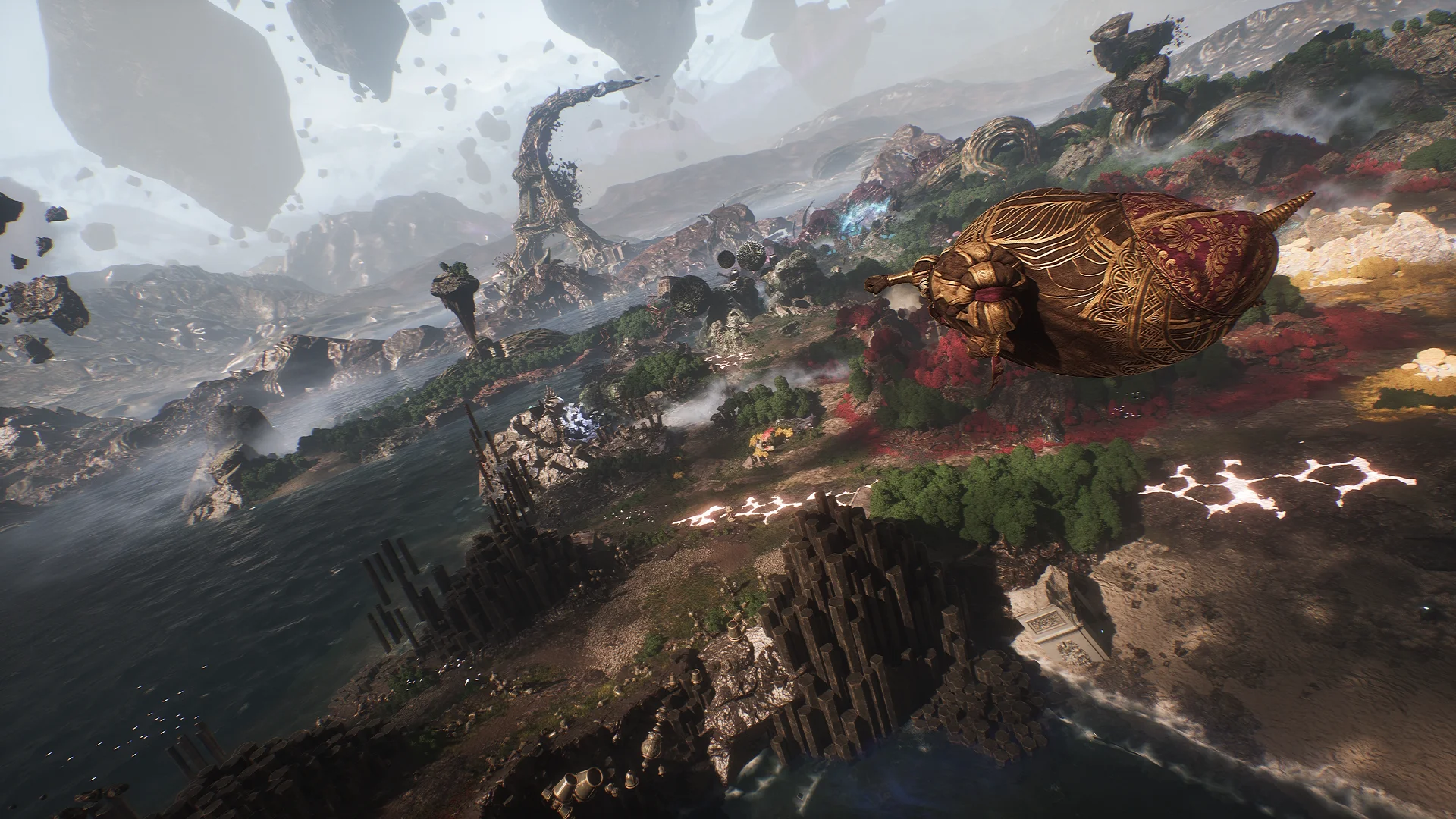
Expedition 33 is set in Lumière, a surreal facsimile of Belle Époque Paris where landmarks like the Eiffel Tower and Arc de Triomphe have been twisted, warped, and broken by a cataclysmic event known as the Fracture. The last humans alive here live under a sentence of collective extinction. Each year, a mysterious entity called the Paintress carves a new number into a monolithic structure on the horizon, and everyone of that age dies. For 67 years, she has been counting down. The game begins as every 34-year-old disintegrates into dust and crimson petals.
It is a premise both immediate and deeply strange, and critics noted that the game trusts its audience completely. Expedition 33 drops players into its melancholy world with a refreshing lack of context. While undeniably a fantasy RPG, it does not begin with scrolling text explaining its universe. In a genre known for slow starts, Clair Obscur steps right over that cliché with conviction and style.
The term “clair-obscure” is a French translation of the Italian “chiaroscuro,” referring to the interplay between light and dark that adds depth to works of art. This applies both to the game’s visuals and its themes, the struggle between life and death, between the Expeditioners and the Paintress, between the past and the future.
The Story: Grief, Mortality, and Human Connection
If the setting is the stage, the narrative is what audiences remember long after the credits roll. Reviewers were nearly unanimous: not since Nier: Automata had critics been so thoroughly captivated by a game’s script. Exploring themes of death, grief, and trauma from multiple angles, and packed with genuinely lovable characters, Expedition 33 stands as a narrative achievement of real weight.
The story wades into loss, grief, family, both the one we’re born into and the one we choose, and the role art can play in helping us cope with death. Getting to know the party through campfire conversations and character backstories is one of the game’s intimate joys, enhanced by an emotionally compelling narrative full of effective surprises.
What makes the characters land is not that they are heroes of destiny, but that they feel human. The outstanding writing, dialogue, and voice acting makes it possible to watch these characters make hypocritical and self-destructive choices and completely understand why. These same characters also have moments of courage, compassion, and love that are powerful precisely because they are not great heroes, just people doing the best they can.
The Combat: Reinventing the Turn-Based RPG
One of the most consistent points of critical praise is what Sandfall did with turn-based combat, a genre many assumed had been left behind by mainstream gaming. Expedition 33 combines turn-based and real-time reflexes, forcing the genre out of its comfort zone. Players can dodge, parry, and counter in real time, chain combos by mastering attack rhythms, and target enemy weak points with a free aim system.
The closest comparison critics drew was to Nintendo’s Mario RPGs: understanding weaknesses and making good choices is essential, but properly dodging and countering makes players feel masterful against the game’s towering boss fights. Countering is especially rewarding, as explosive animations and sound design reward perfect timing with huge damage numbers.
The game evokes Persona with freely aimed projectiles and audaciously presented battle menus. Equippable Pictos allow the party to learn abilities in a manner reminiscent of Final Fantasy IX. Timed button hits bring obvious Paper Mario comparisons. And yet, while the game plays like many others, nothing plays quite like Clair Obscur.
After finishing the game and defeating all the superbosses, one critic considered the gameplay a much deeper and more rewarding version of Paper Mario. The Pictos system encourages tailoring each character to their respective strengths, and managing turn order remains strategically important throughout.
The Soundtrack: A Phenomenon in Its Own Right
No analysis of Expedition 33‘s success is complete without examining its music, which became, improbably, a mainstream cultural event. The game’s soundtrack reached the top of Billboard’s Classical Albums Chart and Classical Crossover Albums Chart in its first week, maintaining the number-one position for six consecutive weeks. Within five months of the game’s release, the soundtrack had amassed over 333 million streams across digital platforms.
The soundtrack was composed by Lorien Testard, for whom Expedition 33 was his first professional video game project. He spent five years on the score, writing 154 unique songs totalling over eight hours of music, ranging from classical opera to heavy-metal rock, with extensive use of leitmotifs for each character and location. Testard was discovered through a SoundCloud post on a French indie game forum. His co-composer, Alice Duport-Percier, composed the vocal lines and served as the primary vocalist, with contributions from a nine-person choir and over thirty additional musicians.
The soundtrack debuted in the UK albums chart Top 20 and topped both the UK vinyl and independent albums charts upon the release of its physical editions, which included a deluxe six-LP box set, an eight-CD box set, and a Monolith edition with a statuette and premium case.
Why the Industry Took Notice
The reaction from the development community was as significant as the reception from players. Hideo Kojima specifically praised Sandfall’s accomplishment, citing the core team’s small size as his ideal way of making games, enough people to execute a vision without the coordination overhead that drags larger studios down.
For many in the industry, Expedition 33 arrived as proof of something important: that a small studio with a singular vision and genuine passion could still produce a game that outshines the biggest productions in the world. Creative director Guillaume Broche acknowledged that what surprised the team most was how deeply the narrative resonated with players – “This is the thing that’s hardest to quantify… the fact that this worked so well, pretty much instantly, this was the thing where we were like, ‘OK, this is one hundred times what we were expecting.'”
The game holds the highest Metacritic user score of all time. On Steam, it maintains an “Overwhelmingly Positive” rating, with 95% of over 100,000 reviews being favorable. It was ranked No. 1 on year-end lists by Associated Press, Rolling Stone, Time, IGN, GameSpot, Game Informer, GamesRadar+, and many others.
What Expedition 33 Actually Means
In a year when the games industry was marked by layoffs, ballooning budgets, and risk-averse sequels, Clair Obscur: Expedition 33 arrived as something genuinely rare: a debut game built with care, shaped by love of the medium, honest in its ambition, and unanimous in its reception. It didn’t just win awards. It made people feel something.
One veteran RPG critic put it plainly: “If this were a Final Fantasy title, it would easily rank among my all-time favorites. Brilliant concept, impeccable soundtrack, awe-inspiring world, satisfying gameplay, one of the most unique stories I’ve ever experienced.”
Sandfall Interactive began with six people, a passion for JRPGs, and a composer found on SoundCloud. They built something that now sits at the summit of gaming history. And according to Broche, Clair Obscur is a franchise name – Expedition 33 is only the beginning.